post
Exploring the Water Cycle: 3 Exciting and Easy Activities for Kids.
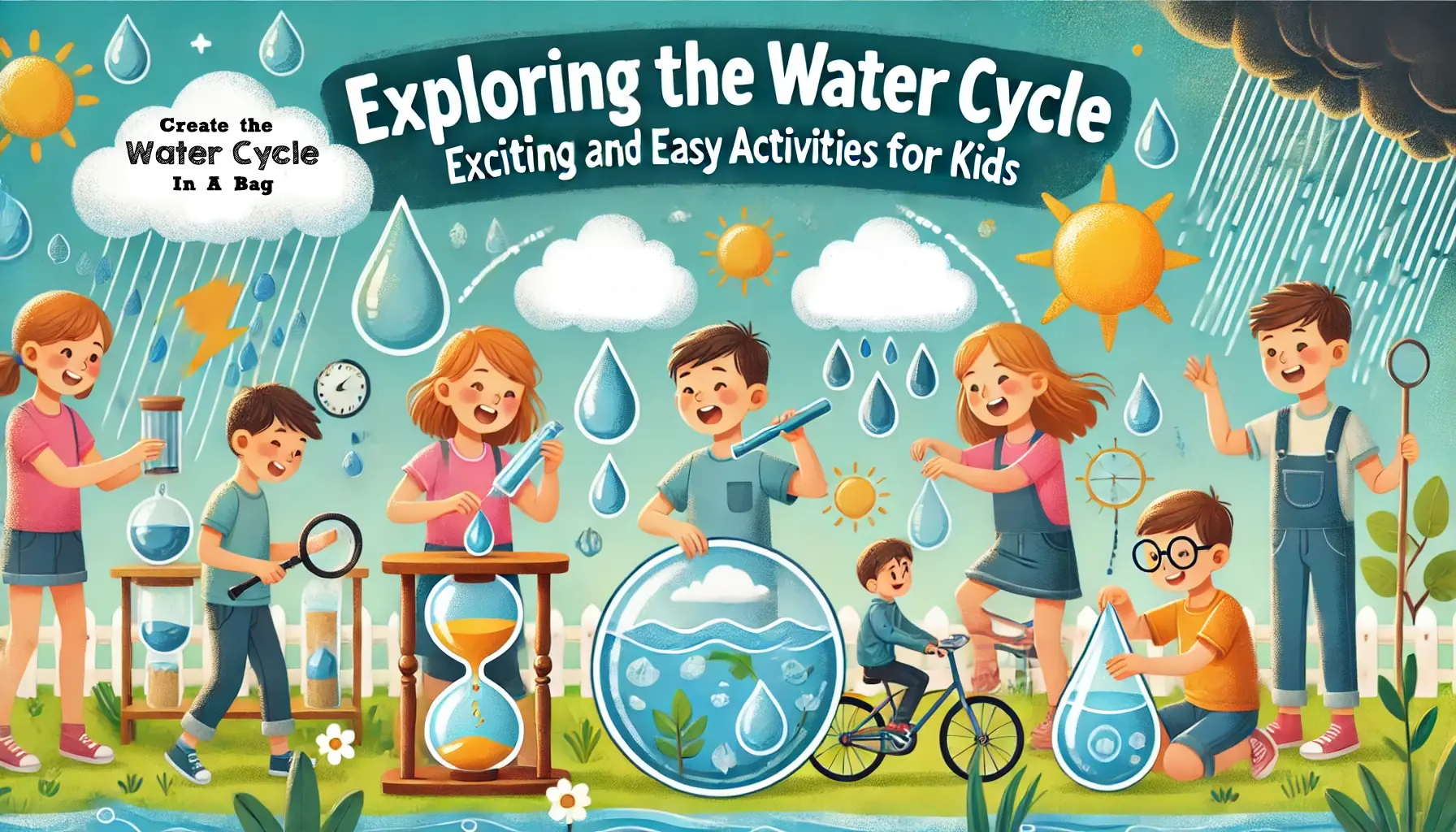
Exploring the Water Cycle: Hands-On Activities for Kids
Teaching the water cycle through interactive and visual activities can be incredibly engaging for elementary school students. These activities can help students grasp the complex processes involved in the water cycle by making abstract concepts tangible. Here's a detailed guide on how to teach the water cycle using hands-on experiments, aligned with NGSS standards related to Earth's systems and water processes.
Introduction
Begin with an overview of the water cycle, explaining the key processes: evaporation, condensation, precipitation, and collection. Use diagrams, songs, anchor charts, or short educational videos to introduce these concepts. Ask students to visualize how a single raindrop travels through the water cycle, reinforcing the idea that the cycle is continuous and connects the land, air, and oceans.
Hands-On Activities
1. Water Cycle in a Bag
Objective: To demonstrate evaporation and condensation.
Materials:
- Ziplock bags
- Water
- Blue food coloring (optional)
- Permanent marker
- Tape
Steps:
- Fill the ziplock bag with a small amount of water and add a few drops of blue food coloring to represent water.
- Seal the bag and tape it to a sunny window.
- Use the marker to draw the sun and clouds on the bag.
- Observe over a few days how the water evaporates, condenses, and drips back down, simulating precipitation.
NGSS Connection: Demonstrates evaporation and condensation.
2. Creating a Mini Rainstorm
Objective: To observe precipitation in action.
Materials:
- A large glass jar
- Hot water
- Ice cubes
- A plate
Steps:
- Pour hot water into the jar to a depth of about 2 inches.
- Place the plate on top of the jar and wait a few minutes.
- Put ice cubes on the plate and observe water droplets forming inside the jar.
NGSS Connection: Models condensation and precipitation.
3. Observing Evaporation and Condensation
Objective: Use everyday items to explore evaporation and condensation.
Materials:
- Two bowls
- Water
- Plastic wrap
- Rubber band
- Small pebble or weight
Steps:
- Fill a bowl with water and cover with plastic wrap.
- Place a small pebble on the plastic over the center of the bowl.
- Leave it in a sunny spot and observe how water moves to the second bowl through condensation.
NGSS Connection: Shows how water transitions between states.
4. Build a Water Cycle Wheel
Objective: Reinforce vocabulary with a visual tool.
Materials:
- Water cycle wheel template
- Scissors, crayons, brass fastener
Steps:
- Color and cut out the water cycle stages.
- Assemble the wheel using a brass fastener.
- Rotate the wheel and discuss each stage.
NGSS Connection: Visualizes cycle flow and systems.
5. Water Cycle Charades
Objective: Use movement to review vocabulary.
- Assign each student a stage (evaporation, precipitation, etc.).
- Students act out the process while classmates guess.
- Discuss how each action fits into the cycle.
6. Sponge Model Activity
Objective: Simulate water movement through the environment.
Materials:
- Sponge
- Tray of water
- Paper towels
Steps:
- Place the sponge in water to absorb liquid (collection).
- Squeeze it over paper towels to simulate precipitation.
- Observe how water soaks and then evaporates from the towel over time.
7. Water Cycle Song
Objective: Help students memorize the stages through music.
- Use a simple tune (like “If You're Happy and You Know It”).
- Have students sing about evaporation, condensation, and precipitation with motions.
- Encourage creativity by letting them write new verses.
NGSS Standards Alignment
These activities align with several NGSS standards:
- K-ESS2-1: Observing local weather conditions to describe patterns over time.
- 2-ESS2-3: Identifying where water is found on Earth.
- 3-ESS2-1: Representing weather data in tables and graphs.
Discussion Questions
- What would happen if one part of the water cycle stopped?
- How does water move through the environment?
- What role does the sun play in the water cycle?
- What was your favorite activity and why?
Tips for Teachers
- Use clear visuals and label diagrams with student input.
- Let students record daily observations in a water cycle journal.
- Encourage students to make predictions before each activity.
- Use cross-curricular connections—writing poems, creating art, or analyzing graphs.
Integrating into Your Classroom
Start with a simple anchor chart and review it often. Display a water cycle poster near your science area and refer to it during lessons. Use learning stations where students rotate through different activities like the sponge model, the bag experiment, or a digital simulation. End with a creative assessment such as having students design a comic strip showing the journey of a water droplet.
Frequently Asked Questions
What grade level is best for water cycle activities?
Water cycle activities are suitable from Kindergarten through upper elementary. You can adjust the complexity of vocabulary and the depth of explanation based on your students' level.
Can these activities be done at home?
Yes! Most activities use household items and are perfect for science learning at home or as part of a family project.
How can I make the water cycle more fun?
Include songs, art, movement-based games, and creative writing. Using a hands-on, multisensory approach keeps students engaged and helps the concepts stick.
Conclusion
Teaching through hands-on activities makes learning interactive and fun for students. By observing and participating in these experiments, students gain a deeper understanding of the processes involved in the water cycle and how they are interconnected, meeting key educational standards along the way. Encourage students to ask questions, make predictions, and reflect on their learning to build scientific thinking.
Additional Resources
For more ideas and detailed instructions on these activities, you can refer to:
By integrating these activities into your curriculum, you provide students with a hands-on, engaging way to explore and understand, building a strong foundation in earth science.
Table of Contents
What is Title 1 in Schools
May 29, 2025 Teaching,Blog,Uncategorized Understanding Title 1, School Site Council, and ELAC: A Parent’s Guide to School Involvement At the... Read More
Back-to-School Strategies That Actually Work
May 29, 2025 Teaching,Blog,Uncategorized Back-to-school strategies that help parents and teachers create strong routines, boost student... Read More
How to Motivate a Child to Learn: 13 Strategies
April 1, 2025 Growth Mindset,Blog,Uncategorized Discover research-backed strategies to motivate a child to learn by fostering curiosity, resilience... Read More
Highest-Paying College Degrees Right Now
March 31, 2025 Blog Choosing the right major is crucial for future earnings. High-paying majors often include... Read More
Top Teaching Trends to Watch in 2025
March 30, 2025 Blog Explore the evolution of education, from technology integration to personalized learning... Read More
Effective Classroom Management for New Teachers
March 29, 2025 Blog Explore the essentials of effective classroom management for new teachers. Learn the importance of... Read More
Fun STEM Activities to Inspire Young Minds
March 26, 2025 Blog Discover the world of STEM for children! This guide explores the importance of Science, Technology... Read More
Is 2025 a Good Year to Become a Teacher?
March 25, 2025 Teaching,Blog Explore the teaching career outlook in 2025. Understand current challenges, future trends, and the... Read More